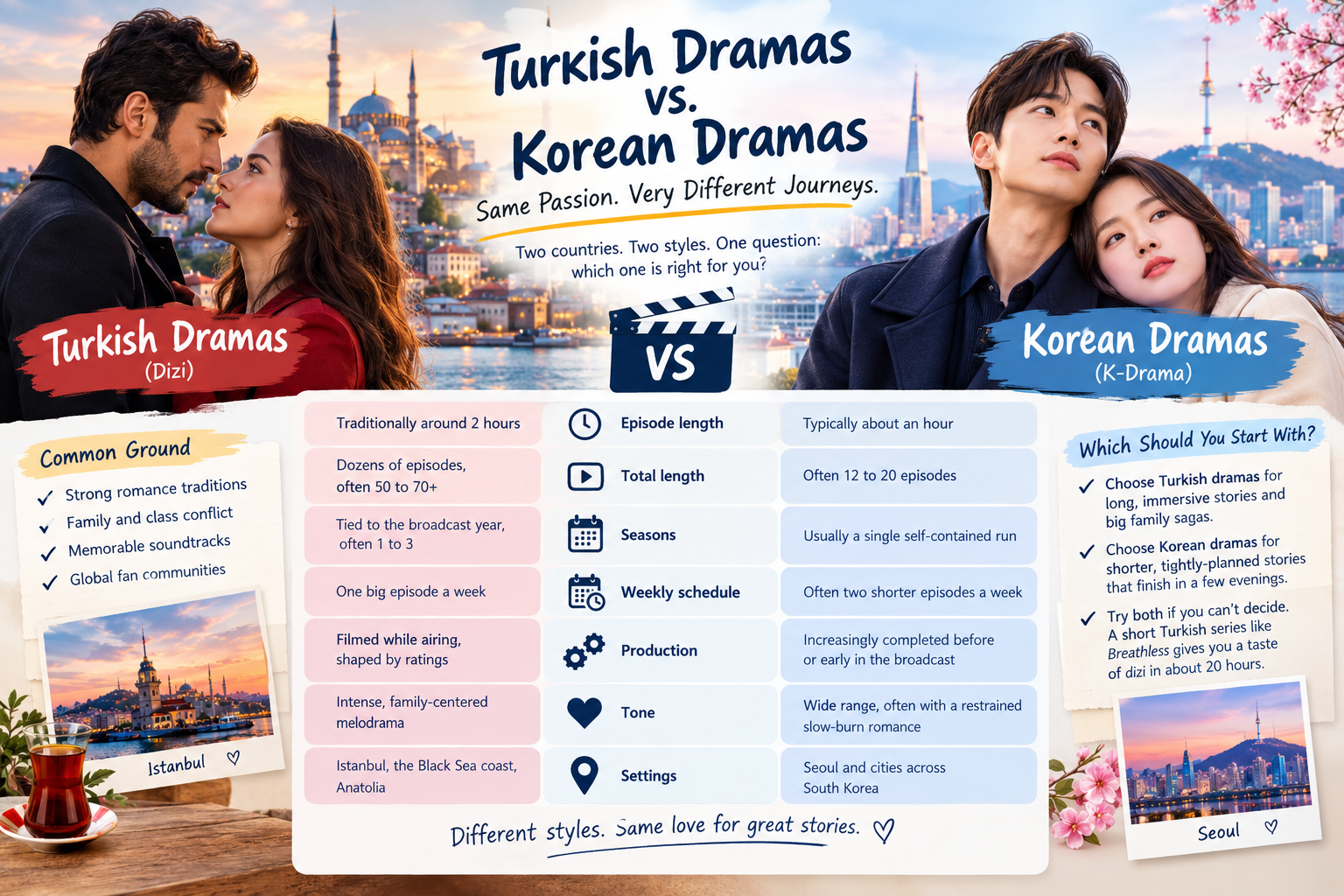
It is one of the first questions new viewers ask: how many seasons does a Turkish series have? The honest answer is "it depends", and the reason is that a Turkish season is shaped by the television calendar and by ratings rather than by a fixed plan. Most series run for one to three seasons, but the number of episodes inside each season can vary enormously.
This guide gives you a clear picture of how the system works, with real examples so you can judge how big a commitment a series really is before you start.
The short answer
The majority of popular Turkish dramas have one or two seasons. A smaller number reach three or more, and some long-running shows continue for many years. A season in Turkey typically follows the broadcast year, running through the autumn, winter and spring, and breaking for the summer. Because each season can contain thirty or forty weekly episodes of around two hours, a single Turkish season often has more screen time than an entire Western series.
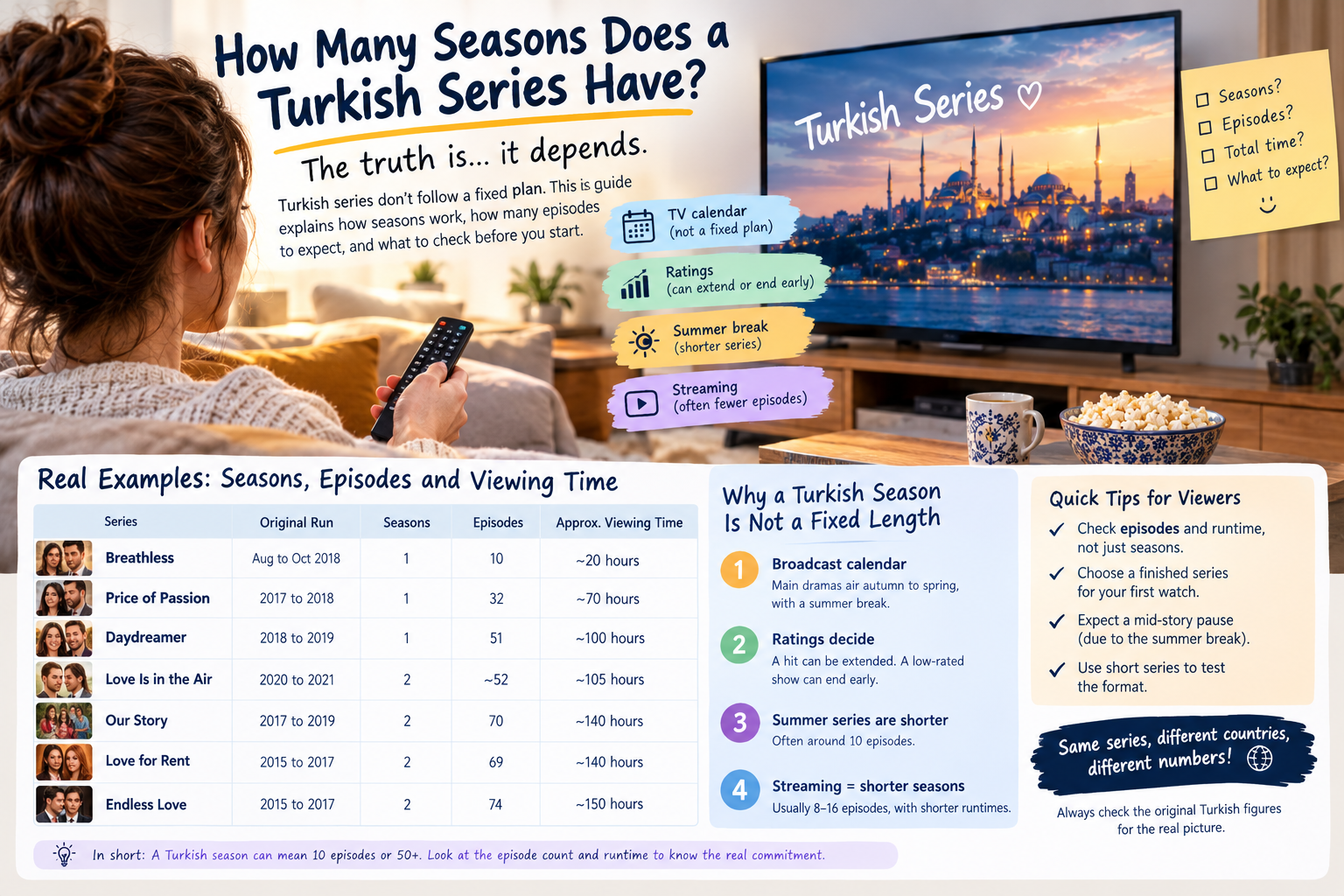
Real examples: seasons, episodes and total viewing time
| Series | Original run | Seasons | Episodes | Approx. viewing time |
| Breathless | Aug to Oct 2018 | 1 | 10 | ~20 hours |
| Price of Passion | 2017 to 2018 | 1 | 32 | ~70 hours |
| Daydreamer | 2018 to 2019 | 1 | 51 | ~100 hours |
| Love Is in the Air | 2020 to 2021 | 2 | ~52 | ~105 hours |
| Our Story | 2017 to 2019 | 2 | 70 | ~140 hours |
| Love for Rent | 2015 to 2017 | 2 | 69 | ~140 hours |
| Endless Love | 2015 to 2017 | 2 | 74 | ~150 hours |
Notice that "one season" can mean anything from 10 episodes to over 50. Counting seasons alone tells you very little, so always look at the episode count and runtime as well.
Why a Turkish season is not a fixed length
1. Seasons follow the broadcast calendar
Turkish channels schedule their biggest dramas for the autumn-to-spring period, with a summer pause. A series that begins in September might air for nine months before the break, which is why one season can hold so many episodes. Love for Rent, for example, premiered in June 2015, completed its first season in June 2016, and returned in September 2016 for a second season that ended in January 2017.
2. Ratings decide how long a show lasts
Because episodes are made while the series is airing, a hit can be extended and a disappointing show can be wrapped up early. Some productions get a second season simply because the audience stayed strong, while others end abruptly. If you want to know how a show ended up, you can check the cancelled shows list and the details on each series page.
3. Summer series are shorter
Channels also schedule shorter series for the summer months. Breathless aired from August to October 2018 and finished after just 10 episodes. These compact seasons are an excellent way to try the format.
4. Streaming has introduced shorter seasons
Series made for streaming platforms tend to follow the Western model of a fixed number of episodes, often between 8 and 16 per season, with shorter runtimes. If you want a lighter time commitment, these are worth looking for, and you can find more recent titles under new episodes and newest shows.
Why season numbers differ between countries
You may find the same series described with different numbers of seasons depending on where you look. International distributors regularly repackage Turkish episodes into shorter parts and then label the blocks as their own seasons. One Philippine channel, for example, aired the first half of Endless Love as a 115-episode "Season 1", even though the original Turkish run was 74 episodes across two seasons. Italian broadcasters aired Love Is in the Air as more than 200 episodes by splitting each long episode into several parts.
When you are comparing sources, check whether the numbers refer to the original Turkish broadcast. We use the Turkish figures throughout this site.
How to plan your viewing
- Check episodes and runtime, not just seasons. A one-season series of 51 episodes is a much bigger project than a two-season series of 20.
- Pick a finished series for your first watch. A completed show gives you the whole story without waiting. Our guide on how to choose a Turkish series to watch explains how to match a series to your time and taste.
- Expect a mid-story pause. Because of the summer break, a season finale is not always an ending. Some seasons stop on a cliffhanger and pick up months later.
- Use short series to test the format. If a long runtime worries you, read our explanation of why Turkish drama episodes are so long and start with a compact title.
Do Turkish seasons end on cliffhangers?
Often, yes. Since a season may be written without knowing whether another will follow, writers frequently end a season either with a satisfying conclusion that could also serve as a series finale, or with a hook to bring viewers back after the summer. For a viewer watching a completed series today, this just means the break between seasons is seamless, and you can continue straight on.
Where to go next
If you are still working out where to begin, our step-by-step plan for starting Turkish dramas covers the practical side, and our picks for the best Turkish dramas for beginners include series of different lengths so you can choose one that fits. You can also browse the complete catalog of Turkish series.
Frequently asked questions
How many seasons does the average Turkish drama have?
Most have one or two seasons. Three or more is less common and usually reflects very strong ratings.
How many episodes are in a Turkish season?
It ranges widely. Summer series may have around 10 episodes, while a full autumn-to-spring season can exceed 30 or even 50.
Why do Turkish series take a summer break?
The major channels concentrate their flagship dramas in the autumn-to-spring schedule, and productions rest during the hottest months. Shorter series fill the summer slots.
Do Turkish dramas always have a proper ending?
Most do, because they are planned as a story with a conclusion. Occasionally a series is ended earlier than planned because of ratings, so it is worth reading about a show before you commit.
Is a second season always a continuation of the same story?
Usually, yes. A second season continues the original story and characters, often after a time jump, rather than starting a new one.